
Win Rummy Strategy: Common Beginner Mistakes to Avoid
The short answer
Unresolved information: No strategy can guarantee an outcome in a real-money card game, and this page does not claim otherwise. What follows are general 13-card rummy principles and the mistakes that most reliably cost new players games, adapted to the table formats Win Rummy lists.
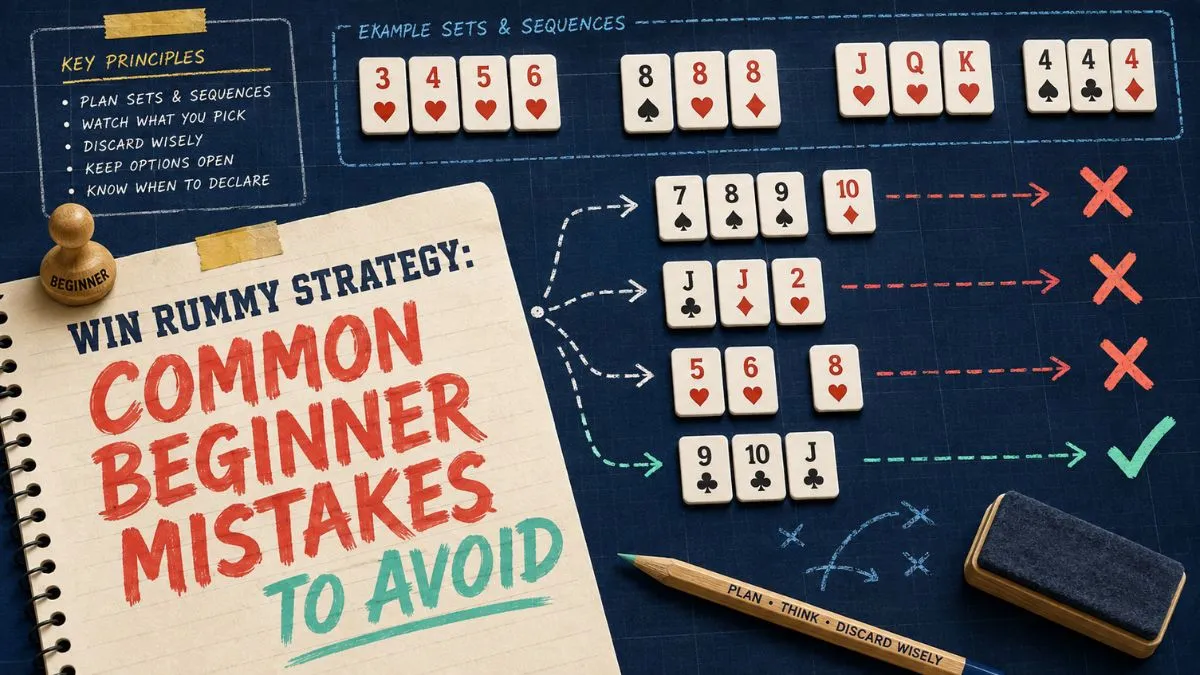
Common beginner mistakes
- Holding onto high-value cards too long. A King or Ace that isn't forming a set quickly is expensive dead weight if an opponent declares first. Discard high cards that aren't working early rather than late.
- Ignoring what opponents discard. Discards are the only visible signal you get about what other players don't need — tracking them, even loosely, tells you which sequences are getting harder to complete.
- Delaying the pure sequence. Most Indian rummy variants require at least one pure sequence (no joker) before a hand can be declared. New players often chase sets first and scramble for a pure sequence too late.
- Misjudging joker value. A joker is worth exactly as much as the card it replaces in the specific meld you use it in — hoarding jokers for a "better" use later often costs more points than using one now.
- Playing every hand the same way regardless of format. A Pool Rummy hand where you're already close to elimination calls for a more conservative discard pattern than an early Points hand where the downside of losing one round is small.
How format changes the right call
Points Rummy — each hand is scored independently, so the cost of folding (dropping) early on a bad hand is small and predictable. Folding a weak hand early is usually correct rather than fighting to complete it.
Deals Rummy — play spans a fixed number of deals with chips distributed upfront, so protecting your chip stack across the full set of deals matters more than winning any single one.
Pool Rummy — points accumulate toward an elimination threshold (commonly 101 or 201), so your risk tolerance should tighten as your running total approaches that limit.
Frequently asked questions
Can strategy guarantee a win in Win Rummy?
No. Rummy is generally classified as a skill-predominant game rather than pure chance, which means better decisions can improve your results over many hands — but no strategy removes the role of the cards you're dealt or eliminates losses on any individual hand.
Is there a single best strategy for every table format?
No. Points, Deals and Pool formats reward slightly different approaches — a play that makes sense when you're trying to minimize points in a Pool game can be the wrong call in a single Points hand. General principles carry across formats, but the specific decision often doesn't.
Do these tips apply to Win Rummy specifically, or rummy generally?
These are general 13-card Indian rummy principles that apply across most real-money rummy apps, including Win Rummy. This page does not describe any Win Rummy-specific mechanic beyond its standard Points, Deals and Pool formats.